MoreExam
1. Question Content...
EXPLANATION
Answer: X - EXPLANATION Content.
Question1: Your finance team wants to view the billing report for your projects. You want to make sure that the finance team does not get additional permissions to the project. What should you do?
Question2: You deployed a new application inside your Google Kubernetes Engine cluster using the YAML file specified below.You check the status of the deployed pods and notice that one of them is still in PENDING status:You want to find out why the pod is stuck in pending status. What should you do?
Question3: You are running an application on multiple virtual machines within a managed instance group and have autoscaling enabled. The autoscaling policy is configured so that additional instances are added to the group if the CPU utilization of instances goes above 80%. VMs are added until the instance group reaches its maximum limit of five VMs or until CPU utilization of instances lowers to 80%. The initial delay for HTTP health checks against the instances is set to 30 seconds. The virtual machine instances take around three minutes to become available for users. You observe that when the instance group autoscales, it adds more instances then necessary to support the levels of end-user traffic. You want to properly maintain instance group sizes when autoscaling. What should you do?
Question4: The core business of your company is to rent out construction equipment at a large scale. All the equipment that is being rented out has been equipped with multiple sensors that send event information every few seconds. These signals can vary from engine status, distance traveled, fuel level, and more. Customers are billed based on the consumption monitored by these sensors. You expect high throughput - up to thousands of events per hour per device - and need to retrieve consistent data based on the time of the event. Storing and retrieving individual signals should be atomic. What should you do?
Question5: You are using Deployment Manager to create a Google Kubernetes Engine cluster. Using the same Deployment Manager deployment, you also want to create a DaemonSet in the kube-system namespace of the cluster. You want a solution that uses the fewest possible services. What should you do?
Question6: You are using Data Studio to visualize a table from your data warehouse that is built on top of BigQuery. Data is appended to the data warehouse during the day. At night, the daily summary is recalculated by overwriting the table. You just noticed that the charts in Data Studio are broken, and you want to analyze the problem.What should you do?
Question7: You want to configure autohealing for network load balancing for a group of Compute Engine instances that run in multiple zones, using the fewest possible steps. You need to configure re-creation of VMs if they are unresponsive after 3 attempts of 10 seconds each. What should you do?
Question8: You deployed an LDAP server on Compute Engine that is reachable via TLS through port 636 using UDP.You want to make sure it is reachable by clients over that port. What should you do?
Question9: You are the organization and billing administrator for your company. The engineering team has the Project Creator role on the organization. You do not want the engineering team to be able to link projects to the billing account. Only the finance team should be able to link a project to a billing account, but they should not be able to make any other changes to projects. What should you do?
Question10: Your company runs its Linux workloads on Compute Engine instances. Your company will be working with a new operations partner that does not use Google Accounts. You need to grant access to the instances to your operations partner so they can maintain the installed tooling. What should you do?
Question11: Your company has a single sign-on (SSO) identity provider that supports Security Assertion Markup Language (SAML) integration with service providers. Your company has users in Cloud Identity. You would like users to authenticate using your company's SSO provider. What should you do?
Question12: Your existing application running in Google Kubernetes Engine (GKE) consists of multiple pods running on four GKE n1-standard-2 nodes. You need to deploy additional pods requiring n2-highmem-16 nodes without any downtime. What should you do?
Question13: You have successfully created a development environment in a project for an application. This application uses Compute Engine and Cloud SQL. Now, you need to create a production environment for this application.The security team has forbidden the existence of network routes between these 2 environments, and asks you to follow Google-recommended practices. What should you do?
Question14: You need to enable traffic between multiple groups of Compute Engine instances that are currently running two different GCP projects. Each group of Compute Engine instances is running in its own VPC. What should you do?
Question15: You are deploying an application to a Compute Engine VM in a managed instance group. The application must be running at all times, but only a single instance of the VM should run per GCP project. How should you configure the instance group?
Question16: You need to manage multiple Google Cloud Platform (GCP) projects in the fewest steps possible. You want to configure the Google Cloud SDK command line interface (CLI) so that you can easily manage multiple GCP projects. What should you?
Question17: A colleague handed over a Google Cloud Platform project for you to maintain. As part of a security checkup, you want to review who has been granted the Project Owner role. What should you do?
Question18: You have been asked to create robust Virtual Private Network (VPN) connectivity between a new Virtual Private Cloud (VPC) and a remote site. Key requirements include dynamic routing, a shared address space of10.19.0.1/22, and no overprovisioning of tunnels during a failover event. You want to follow Google-recommended practices to set up a high availability Cloud VPN. What should you do?
Question19: Your company uses BigQuery for data warehousing. Over time, many different business units in your company have created 1000+ datasets across hundreds of projects. Your CIO wants you to examine all datasets to find tables that contain an employee_ssn column. You want to minimize effort in performing this task. What should you do?
Question20: Your organization uses Active Directory (AD) to manage user identities. Each user uses this identity for federated access to various on-premises systems. Your security team has adopted a policy that requires users to log into Google Cloud with their AD identity instead of their own login. You want to follow the Google-recommended practices to implement this policy. What should you do?
Question21: You want to send and consume Cloud Pub/Sub messages from your App Engine application. The Cloud Pub/Sub API is currently disabled. You will use a service account to authenticate your application to the API.You want to make sure your application can use Cloud Pub/Sub. What should you do?
Question22: You are deploying a production application on Compute Engine. You want to prevent anyone from accidentally destroying the instance by clicking the wrong button. What should you do?
Question23: You built an application on your development laptop that uses Google Cloud services. Your application uses Application Default Credentials for authentication and works fine on your development laptop. You want to migrate this application to a Compute Engine virtual machine (VM) and set up authentication using Google- recommended practices and minimal changes. What should you do?
Question24: Your company implemented BigQuery as an enterprise data warehouse. Users from multiple business units run queries on this data warehouse. However, you notice that query costs for BigQuery are very high, and you need to control costs. Which two methods should you use? (Choose two.)
Question25: You have deployed multiple Linux instances on Compute Engine. You plan on adding more instances in the coming weeks. You want to be able to access all of these instances through your SSH client over me Internet without having to configure specific access on the existing and new instances. You do not want the Compute Engine instances to have a public IP. What should you do?
Question26: You have a website hosted on App Engine standard environment. You want 1% of your users to see a new test version of the website. You want to minimize complexity. What should you do?
Question27: You have designed a solution on Google Cloud Platform (GCP) that uses multiple GCP products. Your company has asked you to estimate the costs of the solution. You need to provide estimates for the monthly total cost. What should you do?
Question28: You have an application that receives SSL-encrypted TCP traffic on port 443. Clients for this application are located all over the world. You want to minimize latency for the clients. Which load balancing option should you use?
Question29: You need to create a Compute Engine instance in a new project that doesn't exist yet. What should you do?
Question30: Your company wants to standardize the creation and management of multiple Google Cloud resources using Infrastructure as Code. You want to minimize the amount of repetitive code needed to manage the environment What should you do?
Question31: You need a dynamic way of provisioning VMs on Compute Engine. The exact specifications will be in a dedicated configuration file. You want to follow Google's recommended practices. Which method should you use?
Question32: You are using Container Registry to centrally store your company's container images in a separate project. In another project, you want to create a Google Kubernetes Engine (GKE) cluster. You want to ensure that Kubernetes can download images from Container Registry. What should you do?
Question33: You want to select and configure a solution for storing and archiving data on Google Cloud Platform. You need to support compliance objectives for data from one geographic location. This data is archived after 30 days and needs to be accessed annually. What should you do?
Question34: You are the project owner of a GCP project and want to delegate control to colleagues to manage buckets and files in Cloud Storage. You want to follow Google-recommended practices. Which IAM roles should you grant your colleagues?
Question35: You manage an App Engine Service that aggregates and visualizes data from BigQuery. The application is deployed with the default App Engine Service account. The data that needs to be visualized resides in a different project managed by another team. You do not have access to this project, but you want your application to be able to read data from the BigQuery dataset. What should you do?
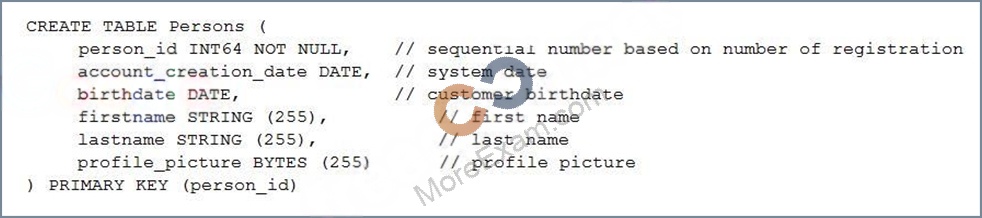
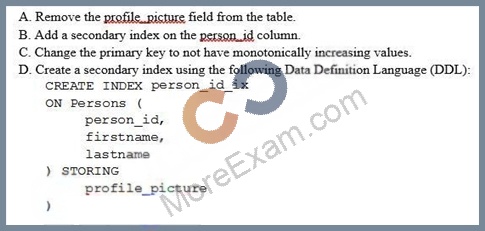
Question36: Your customer has implemented a solution that uses Cloud Spanner and notices some read latency-related performance issues on one table. This table is accessed only by their users using a primary key. The table schema is shown below.You want to resolve the issue. What should you do?
Question37: You are configuring service accounts for an application that spans multiple projects. Virtual machines (VMs) running in the web-applications project need access to BigQuery datasets in crm-databases-proj. You want to follow Google-recommended practices to give access to the service account in the web-applications project.What should you do?
Question38: You need to produce a list of the enabled Google Cloud Platform APIs for a GCP project using the gcloud command line in the Cloud Shell. The project name is my-project. What should you do?
Question39: Your company has a Google Cloud Platform project that uses BigQuery for data warehousing. Your data science team changes frequently and has few members. You need to allow members of this team to perform queries. You want to follow Google-recommended practices. What should you do?
Question40: You need to create a copy of a custom Compute Engine virtual machine (VM) to facilitate an expected increase in application traffic due to a business acquisition. What should you do?
Question41: You have a workload running on Compute Engine that is critical to your business. You want to ensure that the data on the boot disk of this workload is backed up regularly. You need to be able to restore a backup as quickly as possible in case of disaster. You also want older backups to be cleaned automatically to save on cost. You want to follow Google-recommended practices. What should you do?
Question42: Your projects incurred more costs than you expected last month. Your research reveals that a development GKE container emitted a huge number of logs, which resulted in higher costs. You want to disable the logs quickly using the minimum number of steps. What should you do?
Question43: 30. You are running multiple microservices in a Kubernetes Engine cluster. One microservice is rendering images. The microservice responsible for the image rendering requires a large amount of CPU time compared to the memory it requires. The other microservices are workloads that are optimized for n1-standard machine types. You need to optimize your cluster so that all workloads are using resources as efficiently as possible.What should you do?
Question44: Your organization has user identities in Active Directory. Your organization wants to use Active Directory as their source of truth for identities. Your organization wants to have full control over the Google accounts used by employees for all Google services, including your Google Cloud Platform (GCP) organization. What should you do?
Question45: You are the team lead of a group of 10 developers. You provided each developer with an individual Google Cloud Project that they can use as their personal sandbox to experiment with different Google Cloud solutions.You want to be notified if any of the developers are spending above $500 per month on their sandbox environment. What should you do?
Question46: You are working with a user to set up an application in a new VPC behind a firewall. The user is concerned about data egress. You want to configure the fewest open egress ports. What should you do?
Question47: Your management has asked an external auditor to review all the resources in a specific project. The security team has enabled the Organization Policy called Domain Restricted Sharing on the organization node by specifying only your Cloud Identity domain. You want the auditor to only be able to view, but not modify, the resources in that project. What should you do?
Question48: Your company has an internal application for managing transactional orders. The application is used exclusively by employees in a single physical location. The application requires strong consistency, fast queries, and ACID guarantees for multi-table transactional updates. The first version of the application is implemented inPostgreSQL, and you want to deploy it to the cloud with minimal code changes. Which database is most appropriate for this application?
Question49: You need to host an application on a Compute Engine instance in a project shared with other teams. You want to prevent the other teams from accidentally causing downtime on that application. Which feature should you use?
Question50: You need to assign a Cloud Identity and Access Management (Cloud IAM) role to an external auditor. The auditor needs to have permissions to review your Google Cloud Platform (GCP) Audit Logs and also to review your Data Access logs. What should you do?
Question51: Your company set up a complex organizational structure on Google Could Platform. The structure includes hundreds of folders and projects. Only a few team members should be able to view the hierarchical structure.You need to assign minimum permissions to these team members and you want to follow Google-recommended practices. What should you do?
Question52: A team of data scientists infrequently needs to use a Google Kubernetes Engine (GKE) cluster that you manage. They require GPUs for some long-running, non-restartable jobs. You want to minimize cost. What should you do?
Question53: You created a Google Cloud Platform project with an App Engine application inside the project. You initially configured the application to be served from the us-central region. Now you want the application to be served from the asia-northeast1 region. What should you do?
Question54: You are hosting an application from Compute Engine virtual machines (VMs) in us-central1-a. You want to adjust your design to support the failure of a single Compute Engine zone, eliminate downtime, and minimize cost. What should you do?
Question55: You are hosting an application on bare-metal servers in your own data center. The application needs access to Cloud Storage. However, security policies prevent the servers hosting the application from having public IP addresses or access to the internet. You want to follow Google-recommended practices to provide the application with access to Cloud Storage. What should you do?
Question56: You have been asked to set up Object Lifecycle Management for objects stored in storage buckets. The objects are written once and accessed frequently for 30 days. After 30 days, the objects are not read again unless there is a special need. The object should be kept for three years, and you need to minimize cost. What should you do?
Question57: Your company uses a large number of Google Cloud services centralized in a single project. All teams have specific projects for testing and development. The DevOps team needs access to all of the production services in order to perform their job. You want to prevent Google Cloud product changes from broadening their permissions in the future. You want to follow Google-recommended practices. What should you do?
Question58: Your organization has three existing Google Cloud projects. You need to bill the Marketing department for only their Google Cloud services for a new initiative within their group. What should you do?
Question59: You have an application running in Google Kubernetes Engine (GKE) with cluster autoscaling enabled. The application exposes a TCP endpoint. There are several replicas of this application. You have a Compute Engine instance in the same region, but in another Virtual Private Cloud (VPC), called gce-network, that has no overlapping IP ranges with the first VPC. This instance needs to connect to the application on GKE. You want to minimize effort. What should you do?
Question60: You are using Google Kubernetes Engine with autoscaling enabled to host a new application. You want to expose this new application to the public, using HTTPS on a public IP address. What should you do?
Question61: You want to run a single caching HTTP reverse proxy on GCP for a latency-sensitive website. This specific reverse proxy consumes almost no CPU. You want to have a 30-GB in-memory cache, and need an additional2 GB of memory for the rest of the processes. You want to minimize cost. How should you run this reverse proxy?
Question62: You are running a data warehouse on BigQuery. A partner company is offering a recommendation engine based on the data in your data warehouse. The partner company is also running their application on Google Cloud. They manage the resources in their own project, but they need access to the BigQuery dataset in your project. You want to provide the partner company with access to the dataset What should you do?
Question63: You need to create a new billing account and then link it with an existing Google Cloud Platform project.What should you do?